Showing posts with label tubular peyote. Show all posts

Friday, November 15, 2013

Beaded beads

When making beaded beads, I usually bead around a wooden bead, but today I decided to try making beads without a wooden core. I used three sizes seed beads and tubular peyote to make these.


I strung them with some Swarovski briolette beads to see how they would look as a necklace. I think my sister would like this, so even though these beaded beads are primitive, I think I will make some more.


 I was trying out some ideas for beads to submit to the Fire Mountain Gems Circle of Hope project. The beads they collect are then sold on their website, and the proceeds donated so women can receive mammograms (which is why the beads are pink.) I would like to make some more elaborate beads to send to them so I probably will use the wooden beads as a base, but these are fun to make.

Tuesday, October 22, 2013

Berries


When I first poured out a tube of Miyuki mini drop beads I was dismayed at the varied widths at the top of the bead, around the hole. It didn't matter what the color, all of them had the huge size differences. I didn't think of it at the time, but I eventually figured out a way to take advantage of the non uniform sizes. 


I have a friend who is wild about berries. These raspberries were made with her in mind. I had originally been trying to make flower centers out of yellow drops, but I ended up with more of a berry. They are made with five rows of 4 beads each in tubular peyote, gathered at the end with a size 11 seed bead. For the bracts I used size 15 beads to make a simple peyote star with the stem attached. The secret is to use the drops with small tops for the first and last rows and the drops with the widest tops for the middle rows. 
I was surprised I hadn't seen berries made with drops before, it seemed so logical. Then I saw the issue of Beadwork magazine for August/September and it contained instructions for berries that were similar, using drops, but the method wasn't as simple as the ones I made.


Tuesday, September 17, 2013

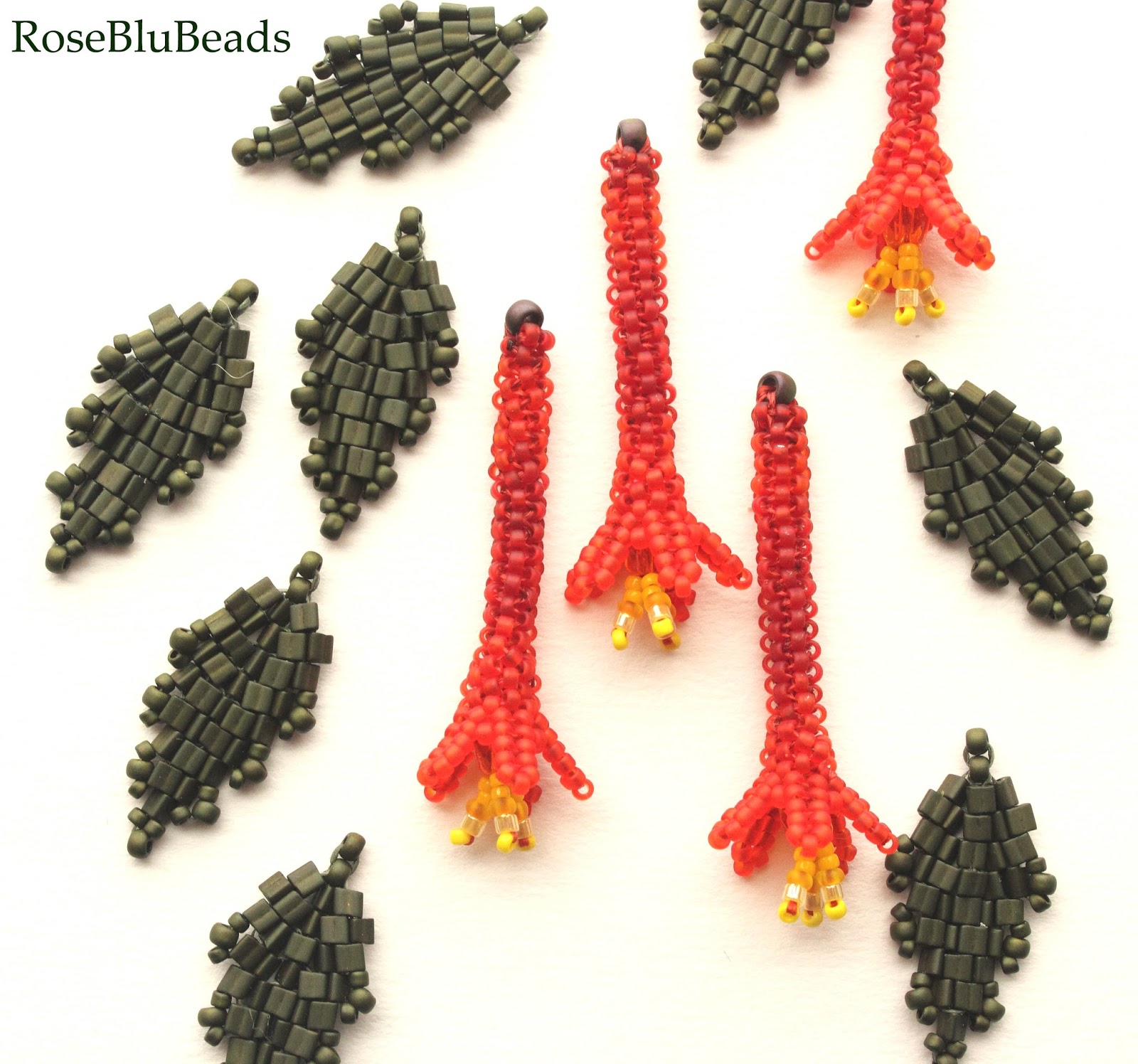
Cape Fuchsia

This week I decided to try one of the flowers on my list, the Cape Fuchsia. Latin name Phygelius, this plant is native to South Africa, and not related to fuchsia.


I made a few flowers that had the wrong kind of bell at the bottom before I remembered to keep it simple. 


I used 3 shades of matte red to make these flowers. The flat 5 petal flower has the matte transparent cherry in the center of the petal, matte transparent Siam ruby filling out to the edges which are matte transparent ruby. I test color combinations by making these flat flowers because you can usually see the subtle differences in the beads. With these reds it was still hard to tell. I used the same three colors in the tubular flower, there the gradation is a little easier to see. I find using colors that are close to each other adds to the overall effect even if the difference is not readily apparent.
The centers of the flowers and insides of the petals are a yellowish orange color.  I used a faceted oval bead to reflect the light and mixed yellows for the stamens.